We have a Google Sheet where a new row is added for each new project and key milestone dates are entered in columns along that row.
Currently, as soon as the first column “project name” is filled in on the Google Sheet the zap runs, missing the other key data.
Currently, I’m delaying the Zap for a couple of days and then only running if all the other columns have a number greater than 0.
I need the zap to run as soon as all the necessary columns on a row have been filled in with a date.
Basically, I need a command that says, “Once columns B-E have a number greater than 0, run the zap.”
I’ve thought about using “New row or Updated row” and targeting a specific column, however, the columns are not always filled in in a specific order.
Best answer by SamB
Just wanted to follow up here to suggest using the New or Updated Spreadsheet Row trigger with a Filter step to check that each column of the row contains a number greater than 0.
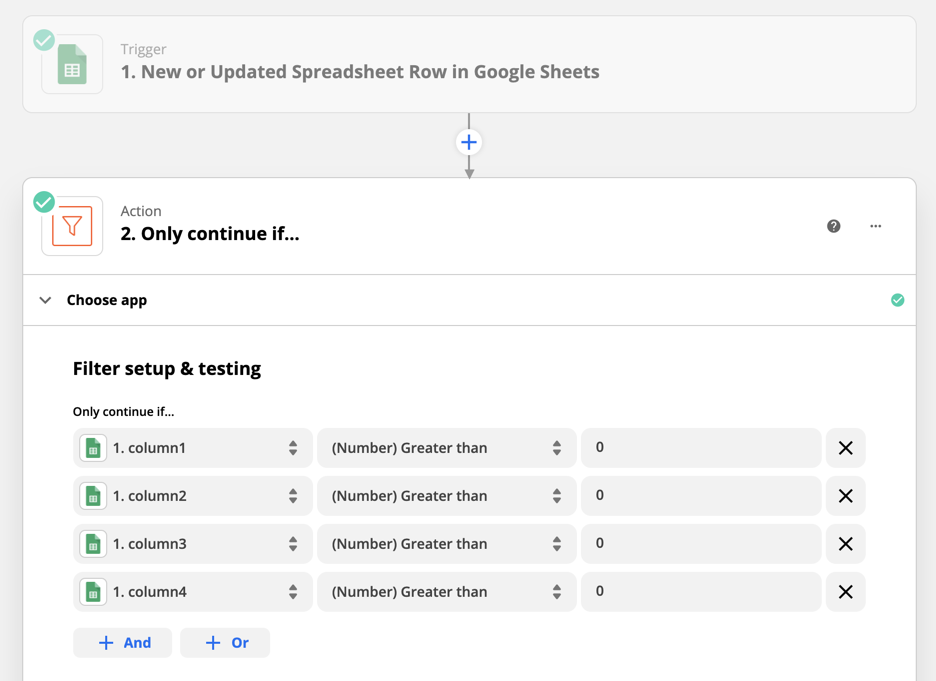
For example, if the spreadsheet had 4 columns you’d select the column from the Google Sheets step and choose the (Number) Greater than rule. Then use the + AND button to add additional conditions for each spreadsheet column to the Filter:
That way the Zap would trigger every time a value is added to the row, but it will only continue to run the next actions in the Zap if each column contains a value greater than 0. And with this method, no formula would need to be added to the spreadsheet.
More details on how to use Filter steps can be found here:
Add another column that is a formula that detects if all the necessary columns are populated, and return a TRUE/FALSE value to then use in the Filter step of the Zap (see more below).
Just wanted to follow up here to suggest using the New or Updated Spreadsheet Row trigger with a Filter step to check that each column of the row contains a number greater than 0.
For example, if the spreadsheet had 4 columns you’d select the column from the Google Sheets step and choose the (Number) Greater than rule. Then use the + AND button to add additional conditions for each spreadsheet column to the Filter:
That way the Zap would trigger every time a value is added to the row, but it will only continue to run the next actions in the Zap if each column contains a value greater than 0. And with this method, no formula would need to be added to the spreadsheet.
More details on how to use Filter steps can be found here:
Build and deploy automations from AI tools you already use. With Agentic Management, if anything breaks, the agent diagnoses the issue and proposes a fix.