
Question

Delay in Sub-Zap, no reason why

  • Oct 16, 2026 4:45 PM UTC
  • 5 replies
  • 51 views

Hi, recently I was getting some delayed status in a sub zap, the main zap gets triggered but once the sub zap started it took 15 min to go through the sub zap and return to the main zap, it happened twice (once it runs, the zap returned the value, so it was marked as completed after all), any idea what’s the problem? It hadn’t happened before. The recent runs are fine


5 replies

Troy Tessalone
Zapier Orchestrator & Solution Partner
Forum|alt.badge.img+14
  • Zapier Orchestrator & Solution Partner
  • Oct 16, 2026 6:56 PM UTC

Hi ​@Vivacioustiger 

Help links for using Sub-Zaps: https://zapier.com/apps/sub-zap-by-zapier/integrations#help


Help link about Delayed Zap Run Status: https://help.zapier.com/hc/en-us/articles/20505304170637-Review-run-statuses-in-Zap-workflows#h_01K7PERCH9W2X4DNV0A9DBA17G


Data must be returned: A sub-Zap must return data. For example, if none of the paths are successful or data is filtered out before returning, the parent Zap run will remain in a Delayed state indefinitely.

  • If you find a parent Zap stuck in Delayed, open the sub-Zap run from that parent Zap and check whether the sub-Zap actually returned any data.
  • To prevent this, add a fallback path to your Sub-Zap. This ensures that if none of the other paths run, the fallback will run and return data to the parent Zap.

juliawhites
  • Beginner
  • Nov 7, 2026 9:54 AM UTC

Could this be a temporary Zapier queue or server delay, especially since recent runs are completing normally?


  • New
  • Nov 9, 2026 1:06 PM UTC

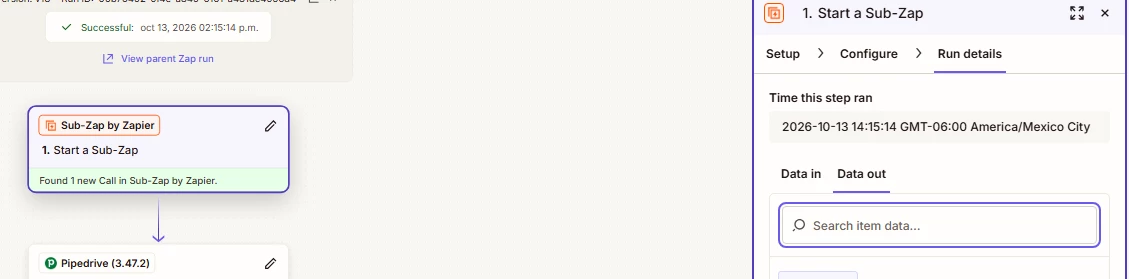
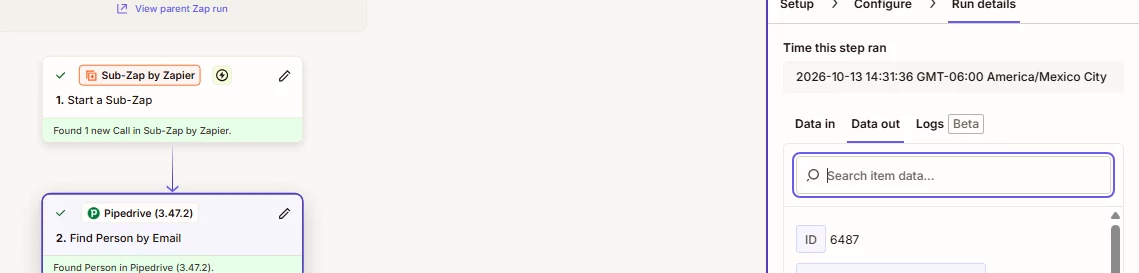
Since recent runs are normal again, a transient queue or retry on the sub-Zap is a strong possibility. The most telling thing to check is the sub-Zap’s own run from inside the parent: if it returned the expected data and finished on its own, the 15-minute gap was just the parent waiting for that response. If the sub-Zap’s run shows a delayed or looping step, the delay is inside the sub-Zap and is usually caused by a heavy action or a Path filter that held the run before it passed through. A quick way to narrow it is to compare the timestamps between consecutive steps inside that sub-Zap run and see where the time disappears.Since recent runs are normal again, a transient queue or retry on the sub-Zap is a strong possibility. The most telling thing to check is the sub-Zap's own run from inside the parent: if it returned the expected data and finished on its own, the 15-minute gap was just the parent waiting for that response. If the sub-Zap's run shows a delayed or looping step, the delay is inside the sub-Zap and is usually caused by a heavy action or a Path filter that held the run before it passed through. A quick way to narrow it is to compare the timestamps between consecutive steps inside that sub-Zap run and see where the time disappears.


A completed run doesn’t by itself establish whether the wait was in Zapier or an external service. Compare one delayed run with a normal one: note the parent call time, the sub-Zap’s start and finish, each visible step’s timing, and the return to the parent. Also compare the path taken and any retry or rate-limit details shown. If it recurs, send support the run IDs and timestamps privately, with sensitive data removed. Avoid replaying a run with external writes until you’ve checked whether those writes already happened.


Drafted with AI help, reviewed by me.


oliverwilliams

Troy nailed the main cause. Check the sub-Zap run itself. Open the delayed parent run and click right into the sub-Zap. Check Data Out. If it shows blank, the parent just sits there and waits. Make sure you put a Return step at the end of every branch. In my experience, setting up a quick fallback path helps a lot, too. That cleared up the exact same hang for me.