


Question

How do you handle failures in complex multi-step automation workflows?

  • September 25, 2026
  • 1 reply
  • 9 views

adnanghaffar

Hi everyone,

I’m curious how others are handling reliability in larger automation workflows.

As workflows grow, especially with multiple apps, APIs, and AI steps involved, I’ve noticed that failures are not always obvious. Sometimes a step fails completely, but other times the workflow technically succeeds while the output is incomplete or unexpected.

Some practices I’ve been exploring:

  • Adding validation checks between important steps
  • Logging key data points for troubleshooting
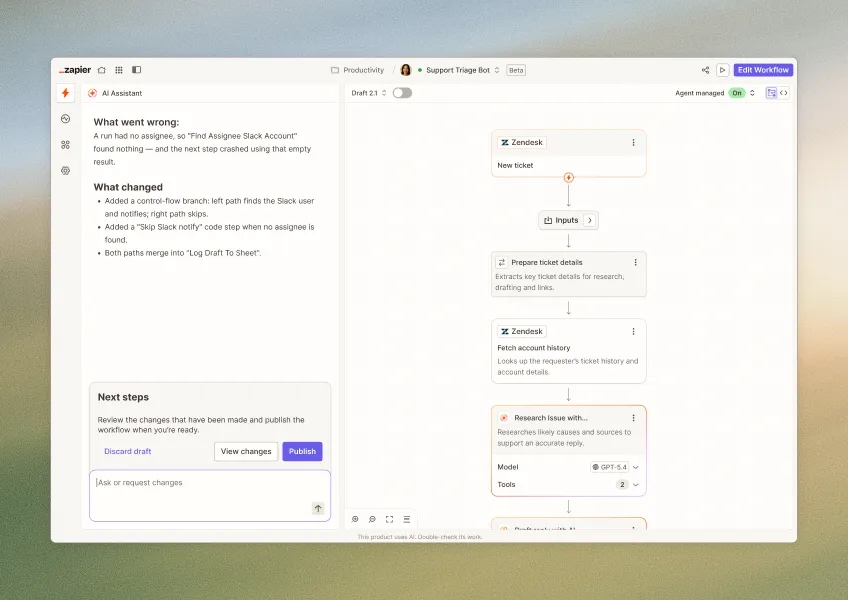
  • Creating fallback paths for failed actions
  • Sending alerts when workflows need attention
  • Tracking business outcomes, not only task completion

I’d love to learn from the community:

  1. How do you monitor workflows that run successfully but produce incorrect results?
  2. Do you use any specific patterns for error handling in multi-step Zaps?
  3. What’s your approach when an external API or AI step becomes unreliable?

Would be great to hear how others are building more reliable automation systems. 🙂
1 reply

  • New
  • September 26, 2026

On "succeeds but produces incorrect results": the trap is treating a 200/success status as proof the output was right. Two patterns that actually catch this: (1) a structural validation step right after anything an AI produces, checking shape/required fields before it's allowed to flow further, not just "did the API call not error"; (2) for anything time-sensitive, re-checking the state you're about to act on right before you act, not just when the trigger first fired. A "wait, then act" step (approvals, delayed sends, scheduled follow-ups) can easily act on stale state if something else changed in between, e.g. the record you're about to update got deleted or already handled by a human.


For unreliable external APIs/AI steps: retry once with a short backoff, then fail loud instead of retrying silently forever, silent infinite retries are how a flaky API turns into a cost or rate-limit problem you don't notice until the bill or the ban shows up. And I'd treat "AI step returned something, but I'm not confident it's right" as its own outcome, not lumped in with "definitely wrong", route that case to a human-review queue instead of forcing a binary pass/fail.


Logging every decision (not just failures) is what actually lets you answer your own question 1 later, you need the "here's what happened and why" trail before you know there's a problem, not after.