
Best practices for managing failed steps in automation workflows

  • September 23, 2026
  • 5 replies
  • 79 views

adnanghaffar

I am exploring ways to build reliable automation workflows using Zapier and would like to learn from experienced users.

What are some recommended approaches for handling failed steps, retries, API limits, and monitoring workflows as automation scenarios become more complex?

I would appreciate insights from users who have experience building and maintaining larger automation workflows.

5 replies

SamB
Community Manager
Forum|alt.badge.img+11
  • Community Manager
  • September 25, 2026

Hi and welcome to the Community ​@adnanghaffar! 👋

We had a similar discussion come up in the community around monitoring Zap workflows which you might find useful:

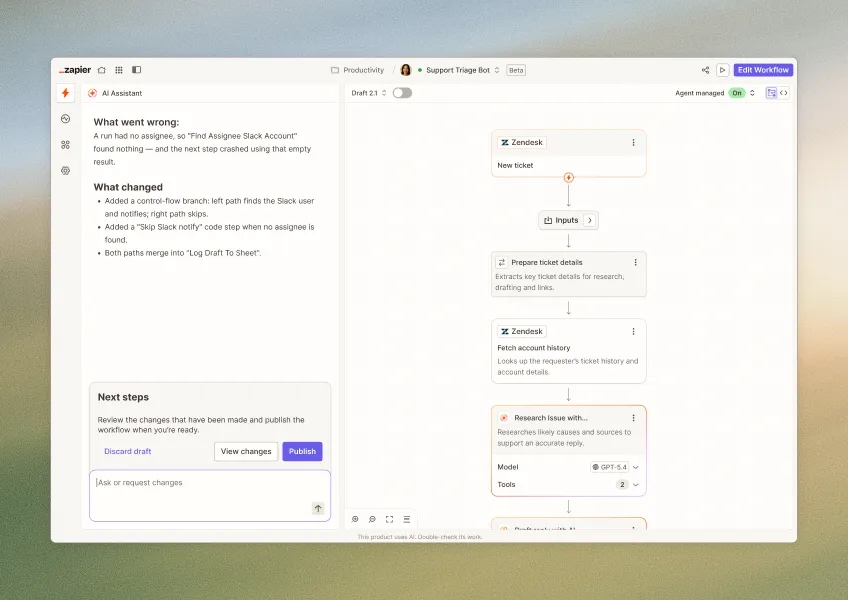
And we’ve got features like Autoreplay, Delay After Queue actions and custom error handlers that you may want to check out. Also worth taking a look at Next Gen Zaps (in Early Access), which are designed for building and managing more advanced workflows from AI tools, and include agentic management to help diagnose issues when workflows break and suggest fixes.

Would love to hear what others recommend too! 


adnanghaffar
  • Author
  • Zapier Solution Partner
  • September 25, 2026

Hi and welcome to the Community ​@adnanghaffar! 👋

We had a similar discussion come up in the community around monitoring Zap workflows which you might find useful:

And we’ve got features like Autoreplay, Delay After Queue actions and custom error handlers that you may want to check out. Also worth taking a look at Next Gen Zaps (in Early Access), which are designed for building and managing more advanced workflows from AI tools, and include agentic management to help diagnose issues when workflows break and suggest fixes.

Would love to hear what others recommend too! 

Thanks for sharing these resources. Monitoring silent failures is definitely an important part of maintaining reliable automation workflows.

One approach that has worked well for us is adding validation checkpoints between critical steps, along with logging key execution details (input data, step status, timestamps, and failure reasons). This helps identify cases where a workflow completes technically but produces an unexpected result.

For larger automation systems, having fallback paths and alerts based on business conditions (not only errors) can also help catch missed runs or incomplete actions.

Curious to know if Zapier has any recommended patterns for detecting workflow runs that complete successfully but don't produce the expected output?


SamB
Community Manager
Forum|alt.badge.img+11
  • Community Manager
  • September 28, 2026

That’s a great approach ​@adnanghaffar! Zapier doesn’t have a specific recommended pattern for this as such, since it depends on what each workflow needs to confirm. But your validation checkpoints along with the fallback paths and alerts are exactly the kind of setup that can help catch cases where a run completes but the output wasn’t as expected.


Really good discussion here. One thing I'd add from my own experience: don't only plan for steps that fail outright — plan for steps that "succeed" but return bad or empty data. After any step whose output matters (an API call, a formatter step, a search), I put a Filter or Paths step that checks the returned field actually contains what I expect before the Zap continues. If it doesn't, I route to an alert — usually a Slack message to myself — so I catch it the same day instead of finding out weeks later in Zap history.


Two smaller things that have paid off for me: turning on the built-in error notification emails for each Zap so nothing fails silently, and for business-critical Zaps, keeping a tiny scheduled "health check" Zap that verifies the key output actually happened that day (for example, that a row was added). It's cheap insurance once a workflow really matters.


Curious whether others here use Zap history exports or any external monitoring on top of the built-in alerts — that's the one gap I still haven't fully solved.


nigelyong

On the gap at the end (external monitoring): what's worked for me is a heartbeat. At the very end of each critical Zap, add a Webhooks by Zapier POST to an external heartbeat/cron-monitoring service, which alerts you if it doesn't hear from the Zap within the expected window. That catches the quiet failures too: the trigger stops firing, the Zap gets turned off, or a Filter silently stops everything. Combine that with the output checks dylan mentioned and you cover both 'didn't run' and 'ran but did nothing useful'.