Question

If You Could Build Your Own AI Assistant, What Would It Do?

  • December 12, 2025
  • 2 replies
  • 18 views

If I could build my own AI assistant, I’d want it to go far beyond the typical task-runner or chatbot we see today. Sure, it should handle scheduling, research, and daily organization—but the real value would come from how safely and responsibly it manages sensitive information. One of the biggest concerns with modern AI tools is accidental data exposure, so my ideal assistant would have strong data protection built directly into its core.

For example, anytime I share personal, financial, or company-specific details, the assistant should automatically apply data redaction, masking or anonymizing sensitive fields before anything is processed or stored. It should never send information to third parties without explicit permission, and it should be able to detect risky patterns—like passwords, client records, or internal documents—before something slips out. Essentially, it would function as a built-in guardian that prevents me from oversharing even by mistake.

I’d also want the assistant to follow the principles of safer AI, similar to frameworks like Questa Safe AI, where transparency, control, and user-centric privacy are defaults rather than optional features. My assistant should clearly explain what data it uses, why it needs it, and how long it keeps it. If I ask, “Delete everything you know about X,” it should do so instantly and verifiably.

Beyond privacy, I’d want it to adapt to my workflow—learning my writing tone, helping brainstorm ideas, automating repetitive digital tasks, and acting as a second brain without ever compromising security. In a world where AI is becoming more integrated into daily life, the perfect assistant wouldn’t just be intelligent—it would be trustworthy by design.


2 replies

Sebastian M
Forum|alt.badge.img+1
  • Zapier Staff
  • December 17, 2025

Hi ​@rom00, welcome to the Zapier Community 👋


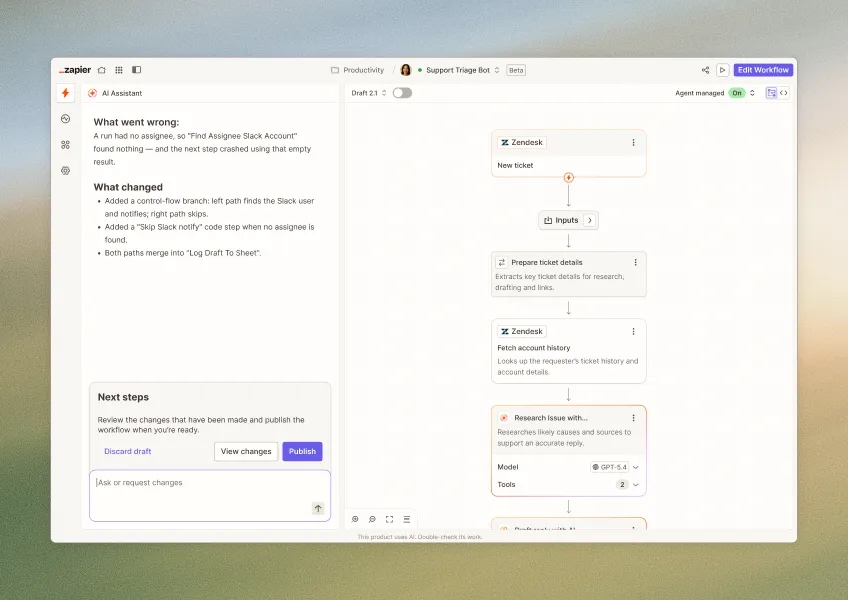
If you want to build a privacy-safe AI assistant with Zapier, a great approach is to control exactly what data the AI sees. Zapier makes this possible by letting you clean or “tokenize” sensitive information before it’s ever passed into an AI step.


A common pattern looks like this:


1. Redact sensitive info first

Use a small Code by Zapier step to replace things like names, emails, phone numbers, or addresses with safe tokens (e.g., [NAME_TOKEN]).

This means the AI only ever sees a privacy-friendly version of the message.


2. Let AI do the “thinking,” not the “doing”

Once the data is redacted, AI can safely handle tasks like:

  • summarizing the message

  • identifying what needs to happen

  • drafting a reply

  • classifying the request

It works entirely on the redacted text, so nothing sensitive is exposed.


3. Reinsert the real data afterward

A second Code step swaps the tokens back to the original values.

So you still get a usable final email, message, or action without the AI ever seeing private details.


This setup gives you a kind of “privacy firewall”:

AI handles interpretation, while Zapier handles the real data securely in the steps before and after.


You can also add approval or routing logic

If you want the assistant to avoid sending data to another app unless you approve it, you can use Human in the Loop to pause Zaps pending human review:


https://help.zapier.com/hc/en-us/articles/38733184458765-Use-Human-in-the-Loop-to-pause-Zaps-pending-human-review


Build transparency into the workflow

You can log every AI interaction in a Sheet or Zapier Table so you always know what was processed and why.


I hope this helps!


drtanvisachar
Forum|alt.badge.img+1

If I could build my own AI assistant, I’d want it to go far beyond the typical task-runner or chatbot we see today. Sure, it should handle scheduling, research, and daily organization—but the real value would come from how safely and responsibly it manages sensitive information. One of the biggest concerns with modern AI tools is accidental data exposure, so my ideal assistant would have strong data protection built directly into its core.

For example, anytime I share personal, financial, or company-specific details, the assistant should automatically apply data redaction, masking or anonymizing sensitive fields before anything is processed or stored. It should never send information to third parties without explicit permission, and it should be able to detect risky patterns—like passwords, client records, or internal documents—before something slips out. Essentially, it would function as a built-in guardian that prevents me from oversharing even by mistake.

I’d also want the assistant to follow the principles of safer AI, similar to frameworks like Questa Safe AI, where transparency, control, and user-centric privacy are defaults rather than optional features. My assistant should clearly explain what data it uses, why it needs it, and how long it keeps it. If I ask, “Delete everything you know about X,” it should do so instantly and verifiably.

Beyond privacy, I’d want it to adapt to my workflow—learning my writing tone, helping brainstorm ideas, automating repetitive digital tasks, and acting as a second brain without ever compromising security. In a world where AI is becoming more integrated into daily life, the perfect assistant wouldn’t just be intelligent—it would be trustworthy by design.

Hello ​@rom00  This is a strong way to frame it and it aligns closely with how responsible automation and AI need to evolve. Capability is no longer the hard part trust and data handling are.

What you describe is essentially an assistant with privacy built in at the architecture level not bolted on later. Automatic redaction consent based data sharing and pattern detection before information ever leaves the system are exactly the safeguards that reduce real world risk. The idea of the assistant acting as a guardian rather than just a processor is an important distinction.

The emphasis on transparency is key as well. Being able to clearly see what data is used why it is needed and how long it is retained should be the default. Verifiable deletion on demand is something users should expect not negotiate for.

If AI is going to function as a second brain and sit close to personal financial or company data it has to earn that position. Systems that are trustworthy by design with clear boundaries and user control are the ones that will actually be adopted and scaled.

Dr. Tanvi Sachar
Monday Certified Partner, Monday Wizard