Question

Agents VS. Workflows?

  • December 7, 2025
  • 3 replies
  • 19 views

What is your experience with Zapier Agents?

I haven't had time yet to do extensive testing of Agents, but most examples (use cases) I've seen are apparently things that can be done with the traditional Zapier workflows/zaps.

Have you been able to do things with Agents that you couldn't do with workflows?

Do you think it's better to use Agents or workflows for things that can be done with both?

I guess workflows are more predictable (AI is not deterministic and hallucinates, so it should be more difficult to control), but maybe modern AI is so good that they are predictable enough and more flexible (less fragile when unexpected errors and changes happen) than traditional workflows?

I’ve read the official documentation, but I want to hear about real experiences from real users. 

3 replies

Troy Tessalone
Zapier Orchestrator & Solution Partner
Forum|alt.badge.img+14
  • Zapier Orchestrator & Solution Partner
  • December 7, 2025

Hi ​@migueleiro 

TIP: Try asking ChatGPT to help you understand the differences and the pros/cons.


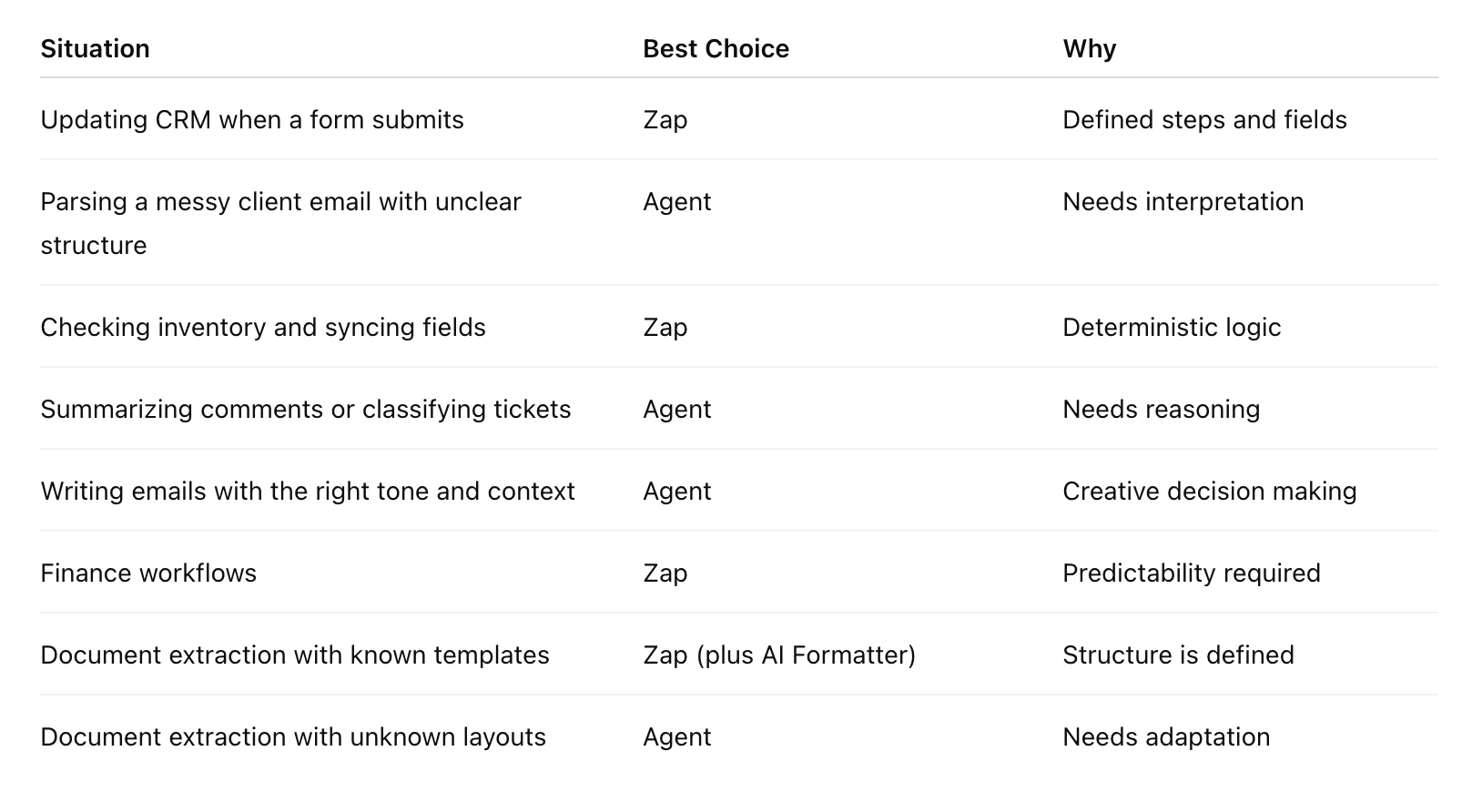
Should you choose Agents or Zaps when both can do the job?

Use this rule:

If the outcome must always be predictable, use a Zap.
If the task requires interpretation or flexible problem solving, use an Agent.


Quick decision tree

Ask these questions:

Is the input structured?
If yes, use Zaps.

Does the logic have a single correct path?
If yes, use Zaps.

Does the automation need to think?
If yes, use Agents.

Can the workflow break if a field is interpreted wrong?
If yes, use Zaps.

Is the task open ended or conversational?
If yes, use Agents.


Zaps vs Agents in Zapier

A practical, real-world comparison

When to use Zaps

Use a Zap when you need:

  • Predictability

  • Deterministic logic

  • Clear step sequences

  • Strict validation and error handling

  • Repeatable data transformations

  • Compliance or auditability

  • Minimal risk of hallucination

  • Fast executions and low task usage

Zaps function like assembly lines. They follow exact instructions every time. If you know your steps, use Zaps.

Typical Zap advantages

  • Fully deterministic

  • Easy monitoring through Zap history

  • Explicit branching and filters

  • Inputs and outputs are guaranteed structures

  • Better for scale

  • Easier debugging

  • No hallucinations

Best suited for

  • Integrations that already have defined rules

  • Data formatting

  • Database sync

  • Notifications

  • Multi-step business workflows

  • Anything that must behave identically every run

When to use Agents

Use an Agent when you need:

  • Open-ended decision making

  • Adaptive logic that cannot be easily expressed with filters and paths

  • Semi-structured tasks

  • Interpretation of unstructured text

  • Crawler-like behaviors

  • Autonomy to pick the next action

  • Logic that changes based on the situation

Agents behave like interns. They try to solve the goal with reasoning and tool use. They fill gaps that are hard to encode as deterministic steps.

Typical Agent advantages

  • Can reason about unclear instructions

  • Can decide which action to take

  • Can troubleshoot unexpected situations

  • Flexible with data formats

  • Can perform multi-hop tasks without predefining every branch

  • Good at handling unstructured information (emails, notes, PDFs)

Best suited for

  • Parsing messy emails or documents

  • Drafting messages with context

  • Trying alternate paths when an API fails

  • Classifying text when categories may change

  • Dynamic decision trees too complex to hardcode

  • Delegating a goal instead of defining step by step

What Agents can do that Zaps traditionally struggle with

These are the actual cases where Agents provide real value.

  1. Interpretation of ambiguous input
    A Zap fails if a value is missing. An Agent can still produce a reasonable output.

  2. Choosing the next action on its own
    Zaps require defined branches.
    Agents choose based on the situation.

  3. Iterative problem solving
    Zaps cannot retry with variable strategies.
    Agents can rethink and attempt a different path.

  4. Multi-tool chaining without predefining steps
    An Agent can pick tools dynamically.
    A Zap cannot modify its own structure.

  5. Handling unexpected states
    Zaps break without perfect assumptions.
    Agents can adapt.

What Zaps can do that Agents are not good at

Important real-world limits.

  • Guaranteed field-level accuracy

  • High-volume scale

  • Precise conditional logic

  • Reliable API integration

  • Compliance and audit history

  • Complex branching that must always behave the same

  • Speed

  • Low cost per run

  • Deterministic scheduling

  • Controlled error handling

Agents are not replacements for operational workflows. They augment them.


Real user experience and behavior patterns

Across consultants and power users, the emerging pattern is:

  • Agents are powerful for unstructured tasks and dynamic decision making.

  • Zaps are still the backbone for mission-critical operations.

  • Most real automations will blend the two.
    The Agent handles interpretation and decision making and passes structured results to a Zap.

Users who tried replacing deterministic Zaps with Agents almost always reverted back because:

  • Agents sometimes hallucinated fields

  • Behavior changed over time

  • Debugging was harder

  • Costs were unpredictable

  • Failure points were vague

Users who deployed Agents successfully used them in:

  • Ticket triage

  • Drafting messages

  • Action selection logic

  • Data interpretation

  • Internal assistants


  • Author
  • New
  • December 8, 2025

@Troy Tessalone As I’ve said, I want to hear about real experiences from real users, so copying here a chatgpt response is not useful. 


Sparsh from Automation Jinn
Forum|alt.badge.img+6

Hey ​@migueleiro,

I understand it can be difficult to choose when to usual Zaps vs the agents. I think mainly you want to use agents when you want the workflow to take autonomous capability rather than a rule based workflows. Agents also can access the web as well as access live data. Usually there will be less control for each step with agents as AI will decide which steps to trigger based on the objective.

I would say that go for deterministic workflows where you can achieve your desired ouput with that. Sometimes you can also do an hybrid version where you use AI by Zapier action or Zapier agents within Zap workflows. The ideal choice would depend on your exact usecase. Hope it helps!